





FLOOR LAMPS FOR THE OFFICE
LED, DIMMABLE, WITH SENSOR
When should you choose a floor lamp for the office?
You should choose an office floor lamp if the lighting at your workspace isn’t quite right and you want to sort it out yourself, without carrying out any building work. Think of a home office with just one ceiling light, an open-plan office where the light above your desk is a bit disappointing, or a consultation room that’s too bright.
Ask yourself a few questions. If you answer ‘yes’ to them, then an office floor lamp is a logical choice.
- Is the ceiling light above your desk too dim, too bright or in the wrong place?
- Do you spend most of the day working at a computer screen?
- Do you want to be able to dim the light and adjust the colour?
- Is drilling into the ceiling not an option, for example in a rented property?
If you only need extra light on your papers or keyboard, a desk lamp will suffice. If you want your whole workspace to be better lit, a floor lamp is the better choice.
Why is an office floor lamp different from a desk lamp?
A desk lamp isn’t any worse than a floor lamp. They just serve different purposes. The difference lies in what is illuminated, how much light there is and where the lamp is positioned.
Direct and indirect light
A desk lamp only provides direct light over a small area. An office floor lamp directs a large proportion of the light upwards towards the ceiling, which gently reflects it back across the room, and a smaller proportion downwards onto your desk. This eliminates the harsh contrast between a brightly lit desk surface and a dark surroundings, which can tire your eyes.
Much higher light output
A desk lamp usually provides a few hundred to around 1,700 lux on the work surface. An office floor lamp such as the MAULsirius delivers over 10,000 lumens and, at a distance of 85 cm, more than 3,000 lux of direct light. The NEN-EN 12464-1 standard specifies 500 lux for office work, so in practice you’ll need to dim such a lamp considerably.
Nothing on the desk
A floor lamp stands on its own base next to the desk. No clamp on the desk top, no base taking up space, no cable across your work surface. With a sit-stand desk, the lamp does not move with the desk top, so the light distance does change slightly when you stand up.
What issues can an office floor lamp help with?
You often only notice poor lighting at your workstation at the end of the day. An office floor lamp with anti-glare LEDs and adjustable colour temperature can help reduce:
- tired, dry or burning eyes after a day of working at a computer screen
- headaches caused by glare or insufficient light
- straining your eyes and leaning forward towards your screen in low light
- a lack of energy in the afternoon, because you’ve been sitting under the same light all day
Light isn’t the only factor. If you still experience headaches or eye strain whilst sitting at your screen every day, you should also consider the distance to your monitor and the use of computer glasses. You can read more about symptoms and causes in the section on pain caused by office work.
What should you look out for when choosing a floor lamp for the office?
Not every floor lamp is suitable for office lighting. Consider the light distribution, glare, adjustment options and the dimensions of the lamp and your space.
Light distribution and light output
Check whether the lamp combines direct and indirect light, and whether you can control both separately. Pay attention to the light output in lumens and the illuminance in lux at working height. Having more light than you need isn’t a problem, as long as the lamp is fully dimmable.
Glare (UGR)
The UGR value indicates how much glare a lamp produces. According to NEN-EN 12464-1, a maximum of 19 applies for computer work; a good, anti-glare office lamp is well below this. The lower the UGR, the gentler the light is on your eyes.
Colour temperature and dimming
An adjustable colour temperature, for example from 3,000 K (warm white) to 5,700 K (daylight white), allows you to adapt the light to the time of day. Stepless dimming is an essential feature. A touch panel on the stand is more convenient than a switch on the lead.
Sensors and energy consumption
A daylight sensor keeps the light level constant, whilst a motion sensor dims and switches off the light when no one is present. This saves electricity. Also check the energy label: since 2021, even energy-efficient LED light sources usually fall into energy efficiency classes D to F, so be sure to compare energy consumption in kWh per 1,000 hours.
Height, base and lead
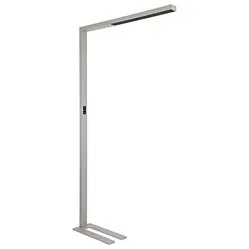
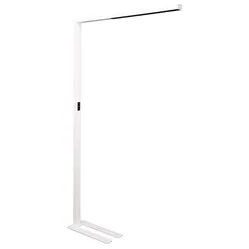
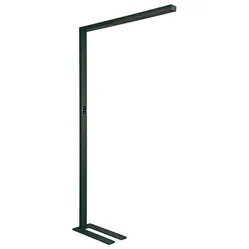
An office floor lamp is often around 195 cm high and has a base measuring approximately 50 x 25 cm. Measure your ceiling height, the space next to the desk and the distance to the socket. If you’re working at a sit-stand desk, bear in mind that the desk top will rise towards the lamp head.
Tips for positioning an office floor lamp
- Place the lamp next to the desk, with the head above the work surface
This ensures the direct light falls on your desk and not into your eyes. Ideally, position the lamp on the side opposite to your writing hand, so you don’t write in your own shadow.
- Keep the ceiling above the lamp clear
The indirect light only works if it hits the ceiling unobstructed. A cupboard, shelf or pendant light above the lamp head will block some of the light.
- Dim the lamp to a comfortable level rather than leaving it on full power
An office floor lamp provides much more light than the 500 lux specified in the standard. Start with the light dimmed and turn it up until your screen and paper are easily readable.
- Adjust the colour temperature according to the time of day
Cooler light around 5,000 K in the morning, warmer light around 3,000 K at the end of the day. This way, you’ll be following the natural daylight outside.
- Let the sensors do their job
Switch on the daylight sensor and let the motion sensor dim and switch off the lamp when you’re away. That saves electricity and you don’t have to think about it.
Frequently asked questions about office floor lamps
- What is an office floor lamp?
A floor lamp measuring around two metres in height, positioned next to the desk, which illuminates the workspace with direct light on the work surface and indirect light via the ceiling. Office models are dimmable, anti-glare and often feature sensors and an adjustable colour temperature.
- Who is an office floor lamp suitable for?
Anyone who spends a lot of time working at a computer screen and is in a place where the fixed lighting is inadequate or causes glare: people working from home, open-plan offices, meeting rooms and rented premises where you’re not allowed to drill into the ceiling.
- How many lux do I need on my desk?
The NEN-EN 12464-1 standard specifies 500 lux on the work surface for office work. An office floor lamp provides well above this level and can be dimmed to a level that suits you. Older people and those with impaired vision often benefit from brighter light.
- Is a floor lamp better than a desk lamp?
That depends on what you want to illuminate. A desk lamp is compact and directs light onto a small area. A floor lamp illuminates the entire workspace and the surrounding area, without taking up space on the desk. For a complete workspace, a floor lamp is the more unobtrusive solution.