





MEDICAL KEYBOARD
HYGIENIC & DISINFECTABLE
When do you choose a medical keyboard?
You choose a medical keyboard as soon as a regular keyboard cannot handle the cleaning protocol. Regular keyboards have open keys with gaps underneath. Dirt accumulates there that you can no longer remove, and disinfectant eventually damages the keys and the print.
In healthcare, a medical keyboard is often simply a requirement of the hygiene policy. Workplaces in treatment rooms, at nursing stations, and in laboratories are disinfected multiple times a day. A medical keyboard with a silicone membrane is designed for this: the material is resistant to common hospital disinfectants.
Even outside of healthcare, a medical keyboard is a practical choice. Consider shared hot desks, reception desks with many changing users, or a workshop where dust and moisture can get into a regular keyboard. Anyone who has ever spilled coffee on a keyboard will immediately understand the appeal of a sealed surface.
Why different from a regular keyboard?
Sealed surface instead of open keys
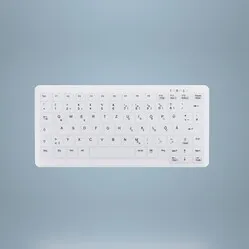
With a regular keyboard, the keys are loose in the frame, with open space underneath. A medical keyboard has a continuous silicone membrane over the entire key field. No seams, no edges, no places a cleaning cloth cannot reach.
Cleaning without disconnecting
Anyone who wipes down a regular keyboard while the computer is on accidentally types half sentences into a patient file. A medical keyboard has the CleanFunction for this: with a key combination, you temporarily disable the key field, clean everything, and then turn it back on. The cable remains connected.
Made for disinfectants
The silicone surface of a medical keyboard is resistant to the disinfectants used in hospitals. The key legends are wear-resistant, so the letters remain legible even after hundreds of cleaning cycles. With a regular keyboard, the legends quickly wear off due to alcohol and cleaning agents.
What complaints can a medical keyboard help with?
A medical keyboard is primarily a hygiene measure, but its design also has ergonomic value. The keys are flat and have a light actuation force of approximately 60 grams, similar to a laptop keyboard. This can help reduce the strain on fingers and wrists, especially with extensive typing. On the page about the ergonomic keyboard, you can read more about what makes a keyboard ergonomic.
The compact versions add something extra. A compact keyboard is narrower, allowing you to use the mouse closer to your body. Your arm then rotates less outwards, which can help reduce tension in the shoulder and upper arm. For those who switch between typing and mousing all day, this makes a significant difference.
What should you consider when choosing?
Removable cover or fully sealed
This is the most important choice. A medical keyboard with a removable silicone cover allows you to clean or sterilise the cover separately, while the keyboard remains at the workstation. A fully sealed version has a fixed membrane with an IP68 rating and can be fully submerged. Please note: IP68 only applies to the fully sealed versions, not to the variants with a removable cover. So, carefully review your cleaning protocol before making your choice.
Compact or full size
A full-size medical keyboard has a complete layout with a numeric keypad, useful for administration and data entry. A compact medical keyboard is narrower and fits better in cramped workspaces, such as a medicine trolley or a small treatment room. Compact also has the ergonomic advantage that the mouse is closer.
Wired or wireless
Wired is plug and play and can never run out of power. Wireless works via a 2.4 GHz connection with a small USB receiver and is convenient in workplaces where the keyboard is often moved, such as a mobile computer cart. Weigh the convenience of no cable against battery management.
Layout and certification
Check the key layout: many medical keyboards have a QWERTY US layout. For use alongside medical equipment, also consider the EN 60601-1-2 standard, which limits electromagnetic interference. Good to know: a medical keyboard is a hygiene product, not a medical device in the sense of European Directive 93/42/EEC.
Tips for setting up a medical keyboard
With these five tips, you'll get more out of your medical keyboard, both in use and maintenance.
- Activate the CleanFunction before cleaning to prevent unintended keystrokes in active files.
- Only use disinfectants approved by the manufacturer to ensure the membrane and legends last longest.
- Place the mouse directly next to the keyboard, especially with a compact version, to keep your arm relaxed.
- Include the removable cover in the cleaning routine at fixed times, so this step is never skipped.
- Periodically check the membrane for wear and damage, because a sealed surface only works if it is truly sealed.
Frequently asked questions about medical keyboards
- What is a medical keyboard?
A medical keyboard is a keyboard with a sealed silicone surface that you can fully clean and disinfect. It is designed for environments with strict hygiene requirements, such as hospitals, practices, and laboratories, and is resistant to common hospital disinfectants.
- Who is a medical keyboard suitable for?
A medical keyboard is suitable for anyone working in a workplace that is regularly disinfected: healthcare staff, lab technicians, receptionists, and users of shared workspaces. Even outside of healthcare, it is a good choice in places where dust, moisture, or many changing hands quickly ruin a regular keyboard.
- Is a medical keyboard waterproof?
That depends on the version. A fully sealed medical keyboard has an IP68 rating and can be submerged for cleaning. A version with a removable silicone cover is not entirely waterproof: in that case, you clean the cover separately and wipe down the keyboard itself with a cloth.
- Is there also a wireless medical keyboard?
Yes, several medical keyboards are available in a wireless version with a 2.4 GHz connection and a small USB receiver. This is useful in mobile workplaces such as computer carts. Also, check out the wider range of wireless keyboards if working wirelessly is your main preference.