





Buying a work chair? From just £189

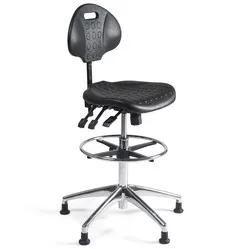
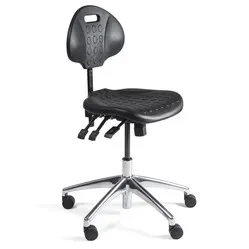
What is a work chair? (Continued)
A work chair often features upholstery that is more resistant to knocks, dirt, or has special properties. A good example of this is an ESD chair, where the upholstery has anti-static properties. Or a cleanroom chair equipped with special filters, so they don't introduce dust into the room when you sit on them.
With a work chair, adjustability is just as important as with a regular office chair you find in an office. To earn the title of ergonomic work chair, it's important that you can adjust the angle and height of the seat and back. Workshop chairs are often supplied without armrests to provide more freedom of movement.
When to choose a work chair
Actually, the choice for a workshop chair is not very difficult. If the chair is going to be used in an environment different from an office space, and other factors such as impact and wear resistance also play a role, then a work chair is already worth considering.
There are different types of work chairs, each with their unique properties. Below are a few examples.
- Cleanroom chair - the name pretty much gives away where you'll primarily find this chair, namely in a cleanroom. This furniture meets strict requirements and comes with filters that prevent dust formation.
- Laboratory chair - also an obvious one. In the lab, this chair provides the necessary comfort. Important features include; upholstery resistant to solvents and easy to clean.
- ESD chair - you'll mainly encounter this chair in a production environment for products sensitive to static electricity, such as electronics.
Is a work chair better than a regular office chair?
The answer can be short. Namely, no. But it's a bit more nuanced than that. In an office environment, a highly adjustable ergonomic office chair is clearly preferred. But as soon as the environment has an impact and other requirements come into play, a good work chair can easily come out much better in comparison.
What complaints does a work chair prevent?
This is comparable to any other ergonomic chair. The most important aspect is that it is well adjustable to the user(s). By using a properly adjusted work chair, you prevent complaints in the back, legs, shoulders, and neck.
A work chair, just like any other ergonomic product, is not a cure on its own. If there are complaints, it is not unwise to look at the workplace and activities as a whole. For example, moving a tray of screws so you no longer have to reach can already make a big difference.
Tips for using a work chair
As with any office chair, it is important to adjust your work chair correctly. Follow the steps below for proper adjustment of the chair.
- Make sure your feet are flat on the floor
When adjusting your office chair, it's important to start from the bottom. If the base is good, you can proceed with adjustments from there.
- Adjust the seat height of the chair
This is correct when the angle between your upper and lower leg is 90˚ or slightly higher. When your hips are slightly higher than your knees, your legs are well supported.
- Sit well back in the chair
The same applies here as in the first step. If you don't sit properly at the back of the chair, you will adjust the chair's settings later based on an incorrect basic posture.
- Adjust the seat depth (if possible)
The 'fist' rule for the correct seat depth is simple. Make sure there is enough space between the edge of the seat and your knee pit so that your fist fits horizontally between them.
- Sit against the backrest and adjust the height
Ensure the backrest is at the correct height for optimal support. The backrest is correctly positioned when the lumbar support falls into the hollow of your lower back, which is often just above the belt line.
- Adjust the lumbar support correctly
In this case, more is not necessarily better. The lumbar support pushes forward and provides good support, but it must remain comfortable.
- Adjust the armrests correctly (if present)
Sit with relaxed shoulders and adjust the armrests so they just support your forearm at a 90-degree angle. If you don't have armrests, skip this and the next step and go to the section "Don't have armrests?".
- Adjust the height of your desk
This is very easy. Once the armrests are at the correct height, ensure the desk surface is at the same height or just slightly below it.
- Don't have armrests?
Then ensure that with relaxed shoulders and an angle between your forearm and upper arm, you are just supported by the work surface. You may need to adjust the height of the surface for this.
If you have followed all the steps correctly, you will probably already be sitting much more comfortably with more support on your work chair. If you still can't figure it out, feel free to contact us on chat for extra tips. You can also read our blog about correctly adjusting your workplace.
Frequently asked questions about work chairs
- Can I try a workshop chair?
Yes, that's possible. Our work chairs come with a 30-day trial period. During this period, you can carefully try it out. Please note that costs may be charged for returns. Read our complete terms and conditions regarding returning your order here.
- I'm unsure which work chair best suits my situation. Can you advise me?
That's no problem, you can reach us via chat, email ( [email protected] ), WhatsApp (076 2600 207) or by phone (076 2600 207).