
















Does eating make you more productive?
Does food really make that much of a difference to your productivity?
What do you think?
When people talk about productivity, they usually focus on the working environment, efficient (or inefficient) processes and leadership. Strangely enough, nutrition is often overlooked, even though its impact is much more direct and can be quite significant.
But just how significant is that impact? The WHO (World Health Organization) has an answer to that question:
“Adequate nutrition can increase productivity by around …”
Ah, increase. So the answer is yes. But just how much impact does nutrition have on our productivity? Would you like to know the answer? It’s at the bottom of this blog. However, it would be more fun if you used the information I’m about to give you to estimate a percentage yourself. Then I’d love to hear in the comments how close you were or how far off the mark you were.
The effect of food
The basic necessity of life
Food is a basic necessity of life. If we don’t eat and drink, our bodies will very quickly start sending signals. Hunger! Thirst! You slow down and start to feel less well. A sandwich and a glass of water, and suddenly you’re back on track. We understand that without food we simply cannot function. Unfortunately, not everyone realises that the exact composition of our daily diet has major consequences.

The right diet
You’re aware of certain effects that food has on us. For instance, eating too much, or food that’s too fatty and sugary (fried food, sweets), makes us overweight and unhealthy. A healthy meal with fruit and vegetables, on the other hand, provides the nutrients our bodies need to grow into big, strong and healthy boys and girls.
The right diet helps us concentrate better, improves our problem-solving skills, stimulates creativity, reduces stress and lowers the risk of falling ill. It really makes a huge difference. You’re less likely to feel depressed and you have better control over your emotions.
A great deal of research has been carried out on healthy eating in recent years, and the internetistherefore full of information.

If you have a browse around the various websites, you’ll soon notice that experts hold differing views on what constitutes a healthy diet. Take, for example, the ‘5-a-day’ guide, a tool for healthy eating used by the Nutrition Centre. Not everyone is 100% behind it. It’s confusing, especially as there’s a case to be made for everything you read. Fortunately, most people do agree on the most important nutrients.
- Proteins
- Carbohydrates
- Fats (the good ones, mind you)
- Vitamins & minerals
- Water
I won’t bore you with the exact details of those nutrients. I’ve already provided you with a few links on that subject. The question we want answered is whether eating really does make you much more productive. That said, I certainly don’t want to keep these 10 healthy and tasty snacks from you.
Prevent your daily slump
The energy we use during the day comes from glucose (or blood sugar), a simple carbohydrate that can be quickly broken down by tissues and provides energy. So, we need to make sure we don’t run out of glucose. That’s absolutely true, but it’s important that we consume glucose in a steady, gradual flow.
A glucose spike causes a brief surge in energy, but is followed by an energy slump. This slump is the result of a sharp rise in insulin production (a hormone that ensures glucose is absorbed and stored). The body processes a large influx of glucose with a large release of insulin. The team at gezondafvallen.nl break it down into bite-sized chunks.
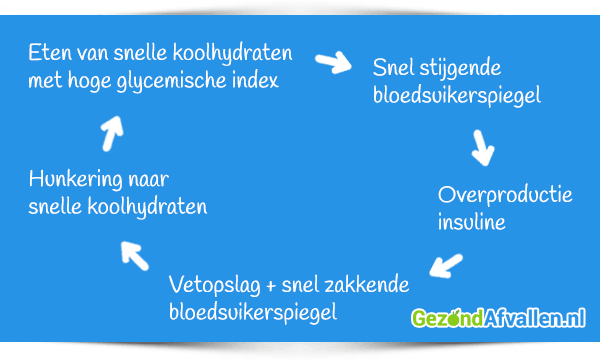
Sugar is the main cause of a glucose spike, because it is absorbed so quickly. That glucose spike therefore comes from sweets, ice cream, biscuits and crisps. For a stable glucose level, it is wiser to consume slower-release carbohydrates. These are found in rice, pasta, fruit and vegetables, amongst other things. It is not just about what you eat, but also what you consume.
A hungry organ
The CEO of our body
"Food? Yes, that’s especially important for people in physical jobs." Not so. Even if you have a sedentary job, eating well is important. Just ask your brain.
Our brains are complex machines. They control everything. They are responsible for what we think, what we feel, how and where we move. Do you know that feeling of your stomach gnawing at itself? That, too, is controlled by the brain. In fact, the brain itself is largely responsible for that empty stomach.

The brain consumes an enormous amount of energy. Although it accounts for only 2% of our body weight, it uses up as much as 20% of our total energy requirements. Your brain cells actually need twice as much energy as any other cell in the body. This is largely due to the nervous system, with which your brain is constantly communicating.
It is therefore important that we can supply our brains with the energy they need throughout the day. If we fail to do so, the fuel runs out and the engine stalls.
Research at work
Stop skimping on the canteen
Several studies have already been conducted into the effects of healthy eating in the workplace. For example, the Health Enhancement Research Organization concluded that employees who eat healthily perform better and are absent less often. Employees who eat healthily throughout the day are 25% more likely to perform better. Eating five or more pieces of fruit, at least four times a week, resulted in a 20% higher likelihood of increased productivity. Employees were also 27% less likely to be absent if they combined healthy eating with sufficient exercise. They were 11% more productive than their overweight colleagues.
In 2014, a study was conducted into the effect of fruit and vegetables. The study lasted 13 days and involved around 400 young adults. It found that if someone consumed more fruit (up to 7 portions a day), they were happier, more engaged and more creative.
Research has also been carried out into unhealthy eating. The consequences of this are perhaps even more alarming. A major study involving three large companies, in which 19,000 people took part, demonstrates this. A staggering 66% chance of reduced productivity was linked to poor nutrition. People aged between 30 and 39 were most likely to experience reduced productivity, whilst those over 60 were least affected.
By the way, are you feeling slightly thirsty? Bear in mind that this alone can cause you to lose 10% of your productivity. Dehydration causes fatigue and even physical ailments such as headaches and dry skin. So make sure you drink enough water. You need around 2.5 litres of fluid a day, of which you should drink about 1.25 litres.
So what does the WHO say?
Any idea? As you’ve read, the right diet has a significant impact on your body and mind. Scroll down a bit further for the correct answer. I’d love to hear what figure you had in mind.