










Clean air in the office
Table of Contents
The importance of clean air
Spaces where clean air is important
Keeping indoor air clean – how do you do it?
Air purifiers from Fellowes
Introduction
Clean air is important – almost everyone knows that. But where, and why? That question is harder to answer. In this blog, we’ll give you all the information you need and show you our top products to help keep the air clean in the office, in a learning environment or in healthcare settings.
The importance of clean air
We spend 90% of our time indoors. Whether that’s at the office or simply at home, we don’t often get out into the fresh air. You may never have given it a thought, but indoor air can sometimes be up to five times more polluted than the air outside.
Offices, educational settings and healthcare facilities are full of people and are therefore breeding grounds for bacteria, viruses, dust and odours. Opening a window (if there is one) often improves air circulation and thus air quality, but this is far from sufficient to fully purify the air.
The consequence of poor air quality is that employees, students or patients breathe in impure air. This can lead to a low oxygen level in the air, which impairs metabolic processes in the brain and consequently makes it harder to concentrate on your work. Respiratory problems, asthma and allergies are the main reasons for visiting a doctor or GP every year.
It is estimated that these complaints cost Dutch employers around €11.5 billion in sick leave. These are costs incurred because an employee is (long-term) ill. This amounts to €3,521 per sick employee. It is estimated that complaints resulting from poor air quality are responsible for 24.6 million days of sick leave per year.
Spaces where clean air is important
Of course, it would be ideal if air quality were at the right level everywhere. After all, we have explained above why that is so important. However, there are locations where good air quality is just that little bit more important. We have listed them for you below.
Offices
A small office of 15 m² can easily accommodate 4 employees (3.75 m² per person). The larger the office space, the less space there is often per employee. It is often the case that the more people in a single space, the dirtier and more oxygen-depleted the air becomes. This is because we breathe in oxygen and breathe out carbon dioxide. The cleaner the air in the indoor environment, the better you can concentrate on your work.
Learning environment
High air quality is also very important in a classroom or other learning environment. An average classroom in the Netherlands is around 50 m², which, with 30 pupils, works out at 1.7 m² per pupil – considerably less than in an office environment. So, more people in a smaller space, leading to less clean air. This is certainly important here too.
Research has shown that clean air improves learning ability. In a test involving computer tasks in which 200 students took part, it was found that they responded significantly faster and more accurately when the room was ventilated more frequently.
Care facilities
In healthcare facilities such as hospitals or care homes, clean air is perhaps even more important. These places often house many people in poor health. What is a simple bout of flu for the average person can be disastrous for some of them. Hygiene, including air purification, is of paramount importance here.
Other locations
Finally, there are other locations where clean air is particularly important. Consider, for example, the living environment of people with asthma or allergies. It is also important to purify the air in rooms where unpleasant odours often linger. Think, for instance, of toilet facilities, changing rooms, or the interns’ office (read: the smell of toasted sandwiches and deodorant).
Keeping indoor air clean – how do you do that?
Ventilation
Unfortunately, the options for keeping indoor air clean aren’t that extensive, but it’s certainly possible. For example, you can ventilate effectively by opening doors and windows (opposite each other) wide, as this creates a draught. Is it too chilly to open the window? Then do so during a break when staff or pupils are elsewhere for a moment; during lunch or when (in secondary schools) pupils are moving between classrooms.
Air-purifying plants
Plants undergo photosynthesis. Put very simply, this is comparable to human breathing. A person takes in oxygen and exhales CO₂. With a plant, however, it works the other way round; it converts CO₂ back into oxygen. This improves air quality. You would therefore be wise to place various plants in your working environment. You can find 5 ideal office plants on our tips page.
Air purifiers
If none of the above options are feasible, you might consider purchasing an air purifier. This filters the indoor air, removing odours, bacteria, viruses, allergens and other impurities from the working environment. You can read more about this below.
Fellowes air purifiers
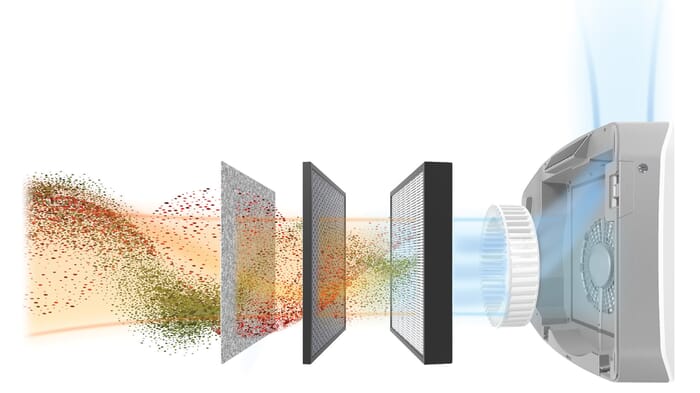
Fellowes’ AeraMax air purifiers are designed to remove up to 99.97% of pollutants such as odours, bacteria, viruses and other pathogens from the air. This is achieved using a filter consisting of 4 components:
- Activated carbon filter
- Hybrid filter
- Pre-filter
- H13 True HEPA
Ergowerken currently has three air purifiers in its range. The main difference between these three is the room size for which the air purifier is suitable. You can easily compare them in the table below. Would you like to find out more about a particular model? Then click on the product name (the ‘Device’ column). This will take you to the relevant product page where you can read all the details.
| Image | Device | Item number | Carbon filter | HEPA filter | Room size in m² | Fan speeds | Noise level (decibels) |
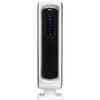 | DX5 air purifier | ERGO-FELRDX5 | Link | Link | 8–12 | 3 | low <30, medium <50, high <60 |
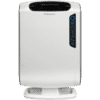 | DX55 air purifier | ERGO-FELRDX55 | Link | Link | 18–28 | 4 | low <30, medium <50, high <60, turbo <70 |
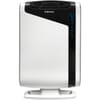 | DX95 air purifier | ERGO-FELRDX95 | Link | Link | 28–42 | 4 | low <30, medium <50, high <60, turbo <70 |