





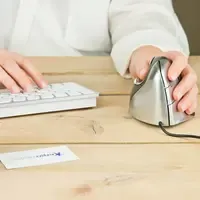





Why use a left-handed mouse if you are right-handed?
Why should you operate the mouse with your left hand, even if you're right-handed?
Let's start with some figures
Statistically, only 10 to 15% of the population is left-handed, with the average for men being 10% higher compared to women. Why would the right-handed population still benefit from a left-handed mouse?
Left- and right-handedness, this phenomenon has occupied neurologists for a long time and remains one of the greatest mysteries of neurology. Most of us make a choice about which preference we have before we are 4 years old. The vast majority, as the percentages above indicate, prefer their right hand. After the preference for the right, the majority of the rest prefer the left. The small number of people who have no preference for left or right (less than 1%) are ambidextrous. Called 'ambidexterity' with a fancy word, and no, it's not a scary disease as the name might suggest, but rather something 'handy'.
We still know very little about this phenomenon, but what we do know about left-handed mousing is:
1. It reduces the risk of RSI-related complaints

Because a right-handed person's right hand is used so often, especially if the person spends a lot of time behind the computer, it is not unlikely that RSI-related issues will develop.
The right hand is used intensively for continuously performing the same types of movements such as writing, reaching for documents on your desk, or turning pages. On top of that comes mouse usage, all movements that are often repeated throughout the day. By operating the mouse with your left hand, you can already reduce one of these factors.
2. Your right hand is more often ‘injured’

Because your right hand is dominant, it is used more often, which also means your reflexes are probably faster in it. So you usually break your fall with your right hand first. In addition, serious office injuries such as the famous papercut occur most often on the dominant hand. If you want to maintain your productivity, it is wise to get used to mousing with your left hand.
3. Practise your ambidexterity (two-handedness)
Who among you can juggle?
Why, if you have two hands, do you usually only use one? By operating your mouse with your left hand, you practise precise movements with your non-dominant hand. For most left-handers, it is normal to perform complex and precise tasks with their right hand, as the whole world is set up for right-handed use. They are therefore practised in using their non-dominant hand. For right-handers, practising the left hand can have benefits even outside the office. The beginning is always difficult, but you'll get used to it faster than you think.
4. You'll work faster
Efficiency baby!
Besides freeing up your right hand to take on all sorts of other tasks, you'll automatically start making more use of the keyboard shortcuts. Look here for all available shortcuts. Or if you work on a Mac, you can look here. Using shortcuts makes you work many times more efficiently. This efficiency gain often comes with a time saving.
6. Take notes and continue working simultaneously

By using your mouse on the left, you can use the mouse simultaneously while entering numbers. You also free up your right hand to use frequently used keyboard functions such as backspace, delete, enter, and cursor keys.
7. Others won't work with your computer
Do you hate it when you ask your colleagues how that one function on your computer was done again, and you immediately lose your mouse and keyboard? That colleague who pushes you aside to confiscate your mouse and keyboard so they can 'show' you the trick, after which you still don't know how to do it because you didn't do it yourself.
Or has your office switched to flexible workstations, but you still want to keep that one spot next to the window? Then set up your computer for a left-hander; this is often enough to deter most right-handers from choosing that spot to work. Instead of 85%-90% of colleagues, you now only have to contend with 10%-15% of colleagues.
8. ‘Because science’

If you are not yet convinced of the benefits that left-handed mousing brings. Then here's a scientific article that might convince you to try it for a month.
8.1 Brain training?
We have known for some time that the dominant hand is related to brain asymmetry. The left hemisphere controls the right side of the body and vice versa. For most of us, language-related matters are also regulated in the left hemisphere. In most cases, this indicates which hemisphere and thus which hand becomes dominant. People who naturally have no preference for a hand generally suffer from poorer cognitive functions than people who naturally have a dominant hand. This is mainly in terms of short- and long-term memory, logic, and arithmetic. This is most likely because the brain has not had the opportunity to specialise in the tasks it excels at.
There is (as yet) no hard evidence that exercising your non-dominant hemisphere has positive or negative consequences. However, numerous scientists speculate that there may be a potential gain in cognitive ability when a right-handed person trains their left hand and vice versa.
8.2 Better posture
For example, there was an American study in which participants were asked to work with the mouse to the left of the keyboard for a month. The volunteers who participated indicated that getting used to the adjustment was easier than expected. It even turned out that movements at the desk were generally smaller and that the posture of the test subjects significantly improved because they did not have to reach as far for the mouse (the study was conducted with a standard 100% keyboard with arrow keys and a numpad on the right side).
After the study, it was found that out of a total of 27 participants, 16 continued to work with the mouse on the left. Link research.
9. You'll have an interesting conversation at the coffee machine

Your colleagues will quickly notice that you, as a right-handed person, are working with a left-handed mouse. You'll get plenty of questions about this; now you can talk about your little experiment instead of Gerda the secretary's trip to the zoo with her grandchildren.
Don't feel like changing your settings every time?
Take a look at our range of mice that can be used by both left- and right-handers.