





Why you should consider migraine glasses – a specialist speaks
Table of Contents
Migraine in the workplace
It starts with light
Difference between Photophobia and Light Frequency Hypersensitivity
Medical filters
Filter lenses work better
The right lens for photophobia and migraine

Specialist's take - Martin Heemskerk
Given the serious nature of a topic like migraine, Ergowerken is pleased to feature a specialist. Martin Heemskerk, an optical specialist with 15 years of experience and founder of B2B Eye Care, is the ideal person for this.
Migraine in the workplace
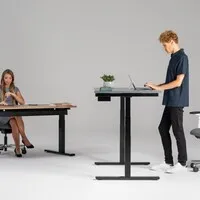
Many people with migraine or severe headaches often suffer from external overstimulation. This can be stress, lack of sleep, too much noise, and so on. Ultimately, the problem arises from the overstimulation of organs and the brain. Many people also appear to suffer from photophobia, also known as light sensitivity. Simply put, this means they are hypersensitive to light. The degree of sensitivity can vary enormously.
As with migraine, light sensitivity comes in many forms. In the workplace, you often deal with bright light sources such as monitors and fluorescent lamps, often for extended periods. The question I want to answer for you now is: can migraine glasses be effectively used against photophobia?
It starts with light
Light can best be described as a form of electromagnetic radiation visible to the eye. Part of it is not visible, which you know as:
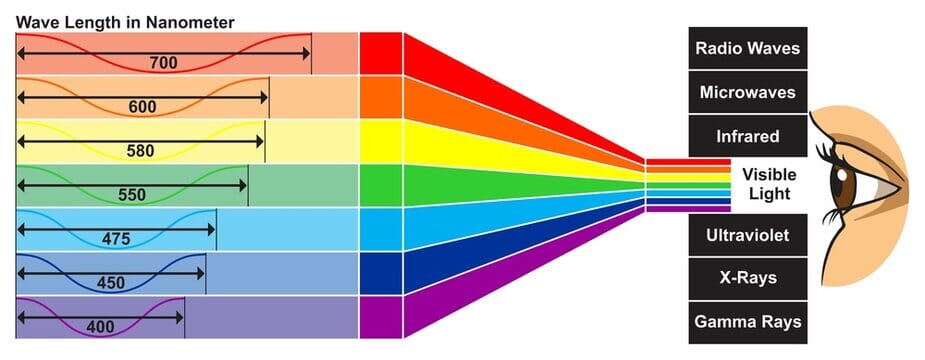
- Gamma rays
- X-rays
- Ultraviolet light (UV-C, UV-B and UV-A)
- Infrared
- Microwaves
- Radio waves
- Visible light (400 nm to 700 nm)
We assume that UV sensitivity stops around 400 nm for everyone. Unfortunately, we are not all made the same, and this can also arise from trauma to the eye or head. As a result, some people suffer more from visible light than others. This can manifest in many different ways. Some well-known ones are;
- Burning / watery eyes
- Neck and forehead tension due to squinting
- Disrupted sleep due to melatonin production disturbance
- Headache due to photophobia
- Headache due to light frequency hypersensitivity
What is the difference between photophobia and light frequency hypersensitivity (LFO)?
Photophobia has to do with the amount of light.
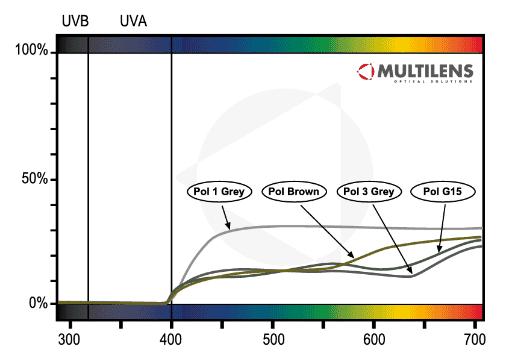
Think of sunglasses. Standard sunglasses block 85% of light. As a result, all frequencies between 400nm and 700nm are attenuated by 85%, leaving only 15% of visible light.
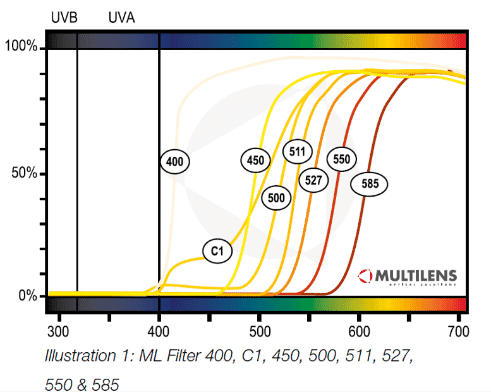
Light frequency hypersensitivity has to do with specific light frequencies. With light frequency hypersensitivity, we remove a certain frequency from the visible light spectrum, or it is partially absorbed. A typical sunglass lens is not used for this. For this specific filtering, we use filter lenses. Filter lenses come in many different frequencies and absorptions. It just depends on what the person needs.
Medical filters
There are numerous causes of light sensitivity. Some well-known ones are:
- Retinal damage
- Thickening of the vitreous humour in your eye
- Eye conditions such as Glaucoma
- Or simply sensitive to too much light
The consequence for your eye is that a disturbance can occur that does strange things with light. Light is no longer processed correctly within the eye, causing it to break up. The colours indigo and violet, in particular, cause irritation, which affects the nerves and brain.
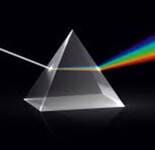
Most sunglasses work reasonably well against this, which is why you often see someone with photophobia and migraine reaching for them.
Reasonably well, but not completely. Sunglasses only attenuate the light and do not filter it. Therefore, sunglasses are not the best choice, as you actually want to filter out the light that causes irritation before it comes into contact with the eye. Additionally, sunglasses are too dark for many situations.
Filter lenses work better
Glasses with filter lenses appear to work much better because they completely filter out certain colours from the colour spectrum. These medical filters are applied, among other things, to people with Blepharospasm (eyelid contraction).
There are also filter lenses that work exceptionally well but do not carry the term 'medical'. These include, for example, FL-41 lenses, also known as comfort lenses. Pilots and drivers already used comfort lenses with yellow glass for night work in the 1970s. The contrast-enhancing effect enabled them to see better in the dark.
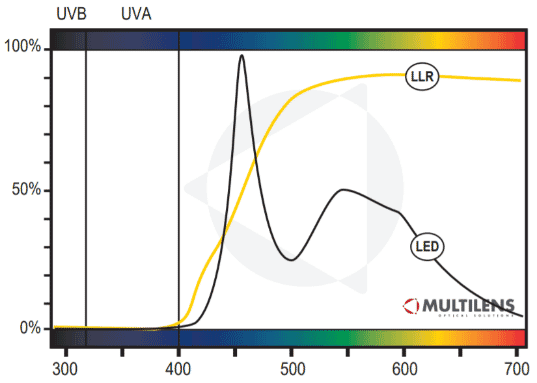
In the years that followed, computers were used more and more frequently. The blue light that mainly came from monitors proved to cause a lot of irritation. The glasses developed later for this filtered out the blue light.
The right lens for photophobia and migraine
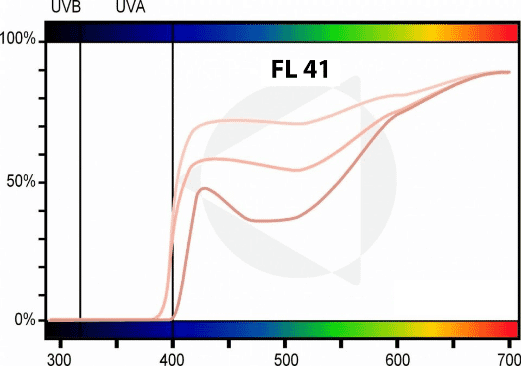
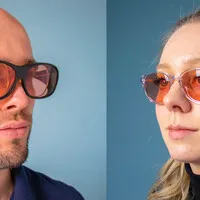
Light that causes the highest hypersensitivity lies between blue/green and green/yellow. A lens that best filters these colours is the FL-41 lens.
Red and yellow are largely retained, so your contrast remains good. The lens is easy to obtain, comes in standard glasses, but can also be fitted into your own frame (with prescription).